“Yay bikes!” the young woman on the sidewalk called out as I rode past.
I waved, then dinged my bike bell a couple of times.
She called out, “Woohoo!” and I smiled as I kept pedaling.
When someone talks about random acts of kindness I think of this welcoming spirit I experience pretty much every time I walk or bike in my town. It’s part of why I live here.
When we started laying plans to move to Olympia during the first summer of the pandemic we shopped neighborhoods first. I’d pick out a neighborhood that had several homes in our price range. We’d drive through slowly, noticing whether people were out walking or biking and how they interacted with each other, how the people driving through behaved. Smiles, waves, a driver slowing down and stopping for someone to cross, all of these went into the information hopper. Did it feel like a neighborhood we’d want to live in, a place we’d be comfortable staying in for the long haul as we aged in place and walked more slowly?
Other factors mattered a lot too. Was the location close enough to my workplace for me to bike there? (Since I couldn’t have dreamed at the time that telework would become permanent and I’d never go into an office on a regular basis again.) Was there a decent (local, non-Starbucks) coffee shop somewhere in the vicinity? How far was it to groceries, restaurants, parks, other places I’d want to visit on a regular basis? Were the streets themselves inviting, with sidewalks and bike lanes? Would I feel comfortable and safe riding or walking there? Did the houses in our price range look from the outside like ones we’d want to live in? Did they have yard space for gardening?
That friendliness on the street? It stopped acting as a differentiator because we found it everywhere, a warm reception that confirmed our choice of town.
I’m thinking now of street as reception space, street as waiting room, somewhat similar to the way I thought about transportation modes as carts in a grocery store and how we behave in skating rinks as a model for behavior on shared streets. What I experience on the street in various neighborhoods is an act of reception, a receiving of me as someone unknown.
How does a street fit with this analogy? Let’s look around a bit.
Do they expect people to be there? Or did they assume this space will be used only for large steel storage units, each one holding a sofa, two chairs, a heater, an air conditioner, a stereo, maybe a TV? Those storage units will take up a lot of space. If they didn’t allow space for people they must not want any customers or clients.
Is there a place for you? Imagine if all businesses that involve waiting didn’t provide space for that purpose. You’d all be crowded outside the door, in each other’s way, blocking the sidewalk for people who need to get by. They in turn would be frustrated. “Why are you there?! Get out of my way! This space is for me, not you!” A street with no safe place to walk, bike, or catch a bus is a dentist’s office with nowhere to wait for your appointment, and now you’re stuck there. (With apologies to dentists.)
Does it have places to sit down? Important on the street for the same reason it’s important in that waiting room: People may be there a while. They may be tired, unable to stand for very long, not able to walk far without stopping to rest, waiting for a bus with a lot of heavy bags.
How’s the lighting? I sure don’t like those waiting rooms with unpleasant old fluorescent tubes that buzz and flicker. They cast harsh shadows, too. I want good lighting I can read by, lighting that makes it feel as if I belong there. If you picture a gloomy waiting room with tiny cones of light, people looming up abruptly out of the darkness to startle you, you’ll recognize why pedestrian-scale lighting on a street matters so much.
Are there things there to make the space a pleasant one? Something to read, something to look at, maybe a bit of nature in the form of plants or living creatures, maybe some art. Imagine a waiting room with bare concrete walls and floor. Now think of a road lined with the backs of warehouses, not a tree in sight.
Why are we there? We share a common purpose. Otherwise we wouldn’t be occupying the same space. Those people in the waiting room have an appointment, or it’s one of those waiting areas in a lobby that provides a space for respite. Those people on the street are going somewhere, or the streetscape is a place they can occupy without having to buy something. Maybe they’re not thrilled to be there—they’re waiting to find out if they need to have a root canal—but it’s essential. Maybe they really enjoy it; they’re looking forward to visiting with their hairdresser or that friendly woman who books their next appointment or they’re waiting for their table at a favorite restaurant. Good, bad or indifferent, this is where they are.
How fast are people moving? A waiting room with people rushing around feels frenetic. You worry about someone tripping over the bag you set by your chair. Someone bumps into another person who’s a little shaky on their feet and maybe they fall, get injured. The adrenaline doesn’t give you fun, exciting energy; instead it’s the nerve-wracking dose that sets you on edge, looking around for the next threat.
How do we behave toward each other? Understanding that we share a common purpose, we take turns. We observe social norms like first come, first served. We make allowances for emergencies that adjust the sequence. Most of us wouldn’t rudely elbow someone else out of the way to push to the front of the line. We don’t shout insults at each other, we don’t accost someone about their reason for being there or why they’re sitting in that spot, we don’t threaten them with our chairs. We make eye contact and smile when someone enters with a baby in a stroller. We jump up to help someone who appears to need a bit of assistance with that heavy door. We commiserate with each other if the wait seems long and share what we know about the possible cause. We ask if we can pet someone’s dog, or we know to leave it alone because it’s a service animal on duty. Someone welcomes us as we arrive and wishes us a good day as we go on our way.
As I reread my earlier pieces on grocery stores and skating rinks, I’m struck by how much better we behave toward each other when we can connect at human scale and human speed. I recognize the convenience and utility of motor vehicles and I drive or ride in them occasionally, but I don’t like what they’ve done to human interactions and to the places we live where we’ve designed for their dominance. I’d rather travel by bike, bus, or walking.
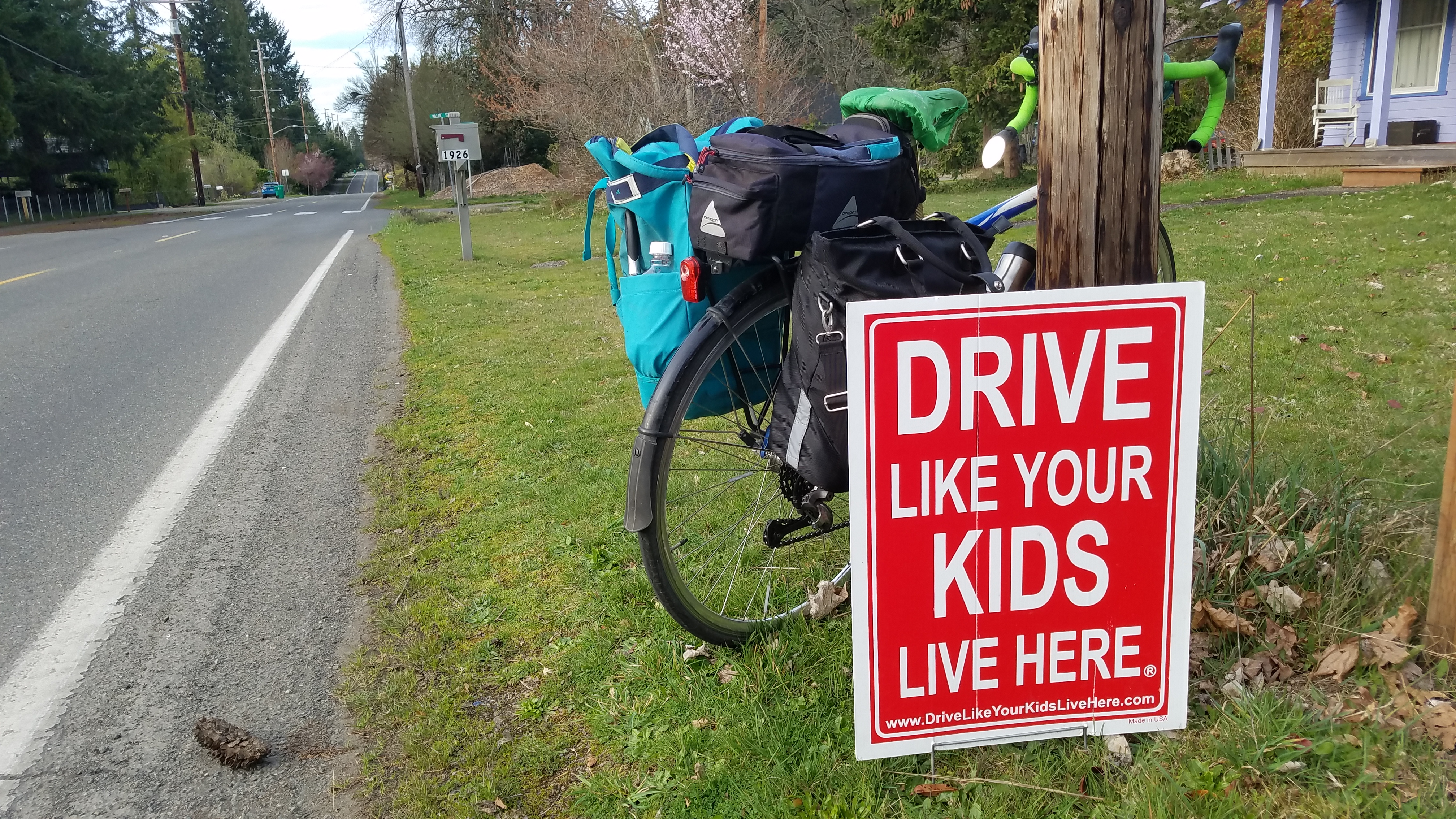
I know privilege played a role in my ability to choose a home in a great neighborhood where people wave and smile, know their neighbors by name, and put up signs from Intercity Transit with statements like “Drive Slowly for a Safer Oly” and “Save Lives, Not Seconds.” I wish for all of us to have that warm reception wherever we live and move.
Related reading
- Real Life on a Bike
- Shared Streets: A Vision
- Model Modal Manners: Move Like You’re in a Grocery Store
- Street of Dreams: Can We Live the Martin Luther King, Jr. Way?
- When I Get Older: Why I Believe in a Multimodal System and Complete Streets
- Personal Privilege and Biking: It Takes More than a Bike Lane to Start Riding
- Riding Thoughts: Privilege Is a Tailwind
- Your “Right” to Speedy Travel Doesn’t Exist