I don’t live in a 15-minute neighborhood or a 15-minute city, one in which I can meet the majority of everyday needs in a 15-minute walk. I find that an imprecise and unimodal measure, though, and implicitly ableist as well.
Imprecise: One of my keystone destinations is the local bakery, 0.8 miles from my house. Google Maps tell me it takes 18 minutes to walk there but I do it often enough that I know my walking pace these days moves me faster than they assume (possibly motivated by the heart-shaped hazelnut shortbread cookies or the almond croissants). There’s a little mini-mart place across the street so if I needed fill-in items like milk or eggs I could get those in that same walk, although in summer I’d be walking right past a local farmette that often has eggs in their tiny stand by a bus stop.
Ableist: As Anna Zivarts points out in a Bloomberg piece, the concept of the 15-minute city embeds ableist assumptions about the ability to get around. I’ve experienced temporary disabilities that affected my transportation use. I expect my body’s abilities to change over time so today’s 15 minutes aren’t my 15 minutes in 10 or 20 or 30 years. Nor is my 15-minute circumference a universal constant applying to all y’all. Whether your neighborhood has any sidewalks at all, let alone ones with ADA-required accessibility features, will also affect your route and the time it takes to travel from one point to another if lack of good connections imposes detours that cost you energy as well as time.
Unimodal: Instead of measuring by walk time, I measure by bike time. Early on in my bike commuting I learned that things I thought of as “far away” weren’t necessarily all that distant in time or place. It was the frustrations of driving that made things feel farther than they were. If instead I rode my bike, enjoying the movement and the feeling of freedom, getting some exercise, looking at things along the way because the pace allowed me to, I enjoyed the trip. The time itself was qualitatively different and better. Time is different on a bike.
One more thing: What destinations are assumed and included? Some things are true for everyone. We need to eat, for example. That makes it easy to measure your access to sources of food. But if you have specific requirements not met in the closest grocery store, the store being a 10-minute walk away doesn’t do you much good. Each person’s map is personalized so the utilities that let you check whether you live in a 15-minute neighborhood or city won’t give you results designed just for you. Hence the need to draw your own circle, do your own mapping.
Try this exercise: Open your favorite online map and check the bike time to get to the destinations you go to most frequently. What’s in your 15-minute neighborhood?
My calculations below don’t factor in the time savings on my e-bike. The list of things I can reach in a given time frame would be even longer if I turned on the juice, although I generally save it for hills and headwinds. Think of this as my acoustic bike list.
My 15-minute neighborhood by bike includes:
- Small park: 2 minutes (so I’d walk)
- Local bakery: 5 minutes
- Elementary and middle schools: 5 minutes (I don’t have kids in them but if I did, they’re right there)
- Community theater: 6 minutes
- Big forested park: 7 minutes (I walk there because I go there to go on a walk)
- Paint store where I got the paint to redo bedroom and office: 11 minutes
- A full-sized locally owned grocery store that includes a postal center: 12 minutes (and they donate to the annual Bike Community Challenge)
- Farmer’s market: 13 minutes
- Community center where I take classes through Parks & Rec: 13 minutes
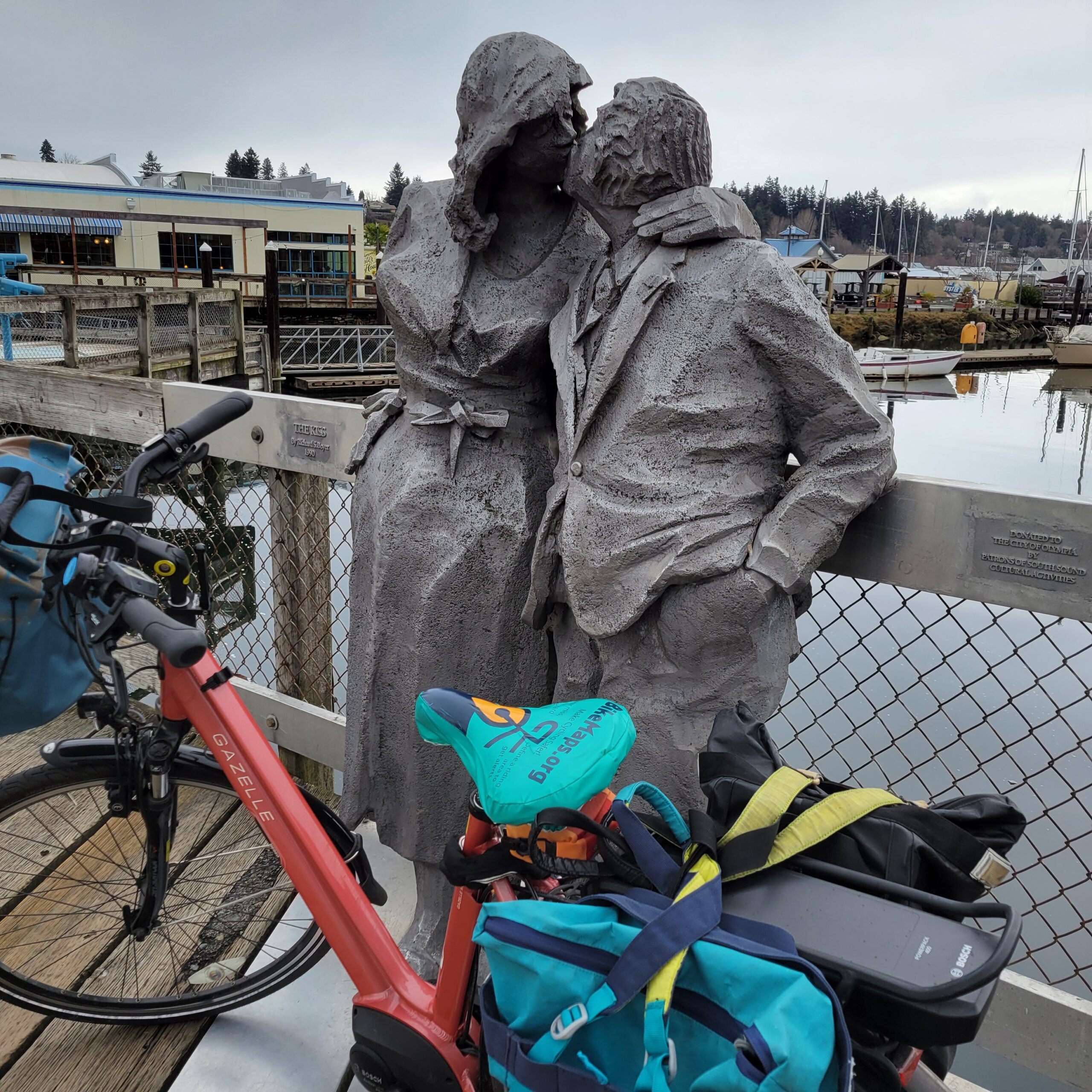
- Downtown with 3 bookstores, shopping, restaurants including vegan comfort food, local coffee, live theater, indie movie house, hardware store, secondhand stores, parks, and the waterfront boardwalk with public art illustrated in the image at the top of this post: 13-15 minutes depending on which end of town I’m aiming for
- Favorite weekend brunch restaurant: 13 minutes
- French pastry place: 13 minutes
- Local yarn shop: 14 minutes (a block past the pastry place)
- Library: 15 minutes
- Post office: 15 minutes
An extra 5 minutes by bike feels like nothing. In a ride of 20 minutes or less I can be at:
- Food co-op: 18 minutes
- My healthcare provider: 20 minutes
- My office, should I decide or need to be in the building instead of teleworking: 20 minutes (with secure bike storage and also the ability to bring my bike right into my office)
- A bunch of other things I haven’t needed in the four years I’ve lived here
A 25-minute ride pulls in:
- My dentist: 23 minutes, with a trail for much of the distance that makes it such a nice ride
- A national chain hardware store: 23 minutes
- A bigger chain grocery store: 24 minutes
- Yet more places I haven’t been but could reach if I needed to
30 minutes:
- An entire shopping mall, including a big movie theater: 27 minutes
- A bunch of other destinations, from restaurants to parks to shopping, and yet more bakeries
35 minutes:
- Nordstrom Rack: 31 minutes
- My hairdresser, who does a great job with my fine, straight hair: 32 minutes
- Yet more parks, grocery stores, shopping, blah blah blah
Farther out:
- Amtrak station that I use roughly once a month: 51 minutes, much of it on a trail (and passenger trains in Washington have dedicated bike racks in the baggage car)
Transit: I don’t measure my neighborhood in terms of transit time. That’s harder to pin down because total elapsed time will depend on when I need to start in order to get to my destination if transfers are involved, and it will depend on whether it’s a weekday (30-minute service until 8pm) or weekend (60-minute service until 8pm). This means bike time is often faster than transit time.
I do love my fare-free service and use it regularly. One of my favorite multimodal combos isn’t aimed at transportation time efficiency at all: Walk with my sweetheart to downtown, going along the water so we can watch the birds and look for seals. Go to the farmers’ market, maybe get coffee or brunch, maybe I pick up a book I ordered that’s waiting for me at the bookstore. Time this so we can catch the bus home; there’s a stop five minutes from our house. This was one of the location attractions when we bought this place since we’re planning ahead to maintain our transportation independence when we age out of driving.
All of this is to say that thinking and mapping in terms of time rather distance and the modes that work for you will help you draw your own map of 15, 20, 25 minutes. You might decide you can try shifting a trip or two to experience a different kind of time travel.
Related reading on the blog
- #30DaysOfBiking, Day 9: A Quick Grocery Jaunt
- #30DaysOfBiking, Day 8: Bikes are So Handy
- Challenges: My #Errandonnee Track Record
- Errands by Bike Are a Breeze (and Sometimes Breezy): Errandonnee 2018
- Beating the Bus, and Other Bicycling Benefits
- Biking Is the Spice of Life
- Car, Bike, Bus: 3 Transportation Perspectives
- Bike, Transit, Car: Three Transportation Perspectives from Seattle
- Setting My Own Pace
- Biking as Downtime and other Musings on Overproductivity
- It’s All in the Attitude
Related reading in other spaces on the 15-minute city or neighborhood
- The 15-Minute City (99% Invisible)
- A universal framework for inclusive 15-minute cities (Bruno, Melo, Campanelli, and Morelo, 2024)
- The ‘15-Minute City’ Isn’t Made for Disabled Bodies (Anna Zivarts on Bloomberg)
- Exploring the 15-Minute City Concept and Its Potential for Communities of All Sizes (National League of Cities)
- 7 Rules for Creating “15-Minute Neighborhoods” (Strong Towns)
- The 5-minute neighborhood, 15-minute city, and 20-minute suburb (Congress for the New Urbanism)
- CityAccessMap (doesn’t have results for all cities; my town isn’t in the database)
- Why so many Americans prefer sprawl to walkable neighborhoods (Washington Post; includes a mapping app and my town is analyzed in this one)